
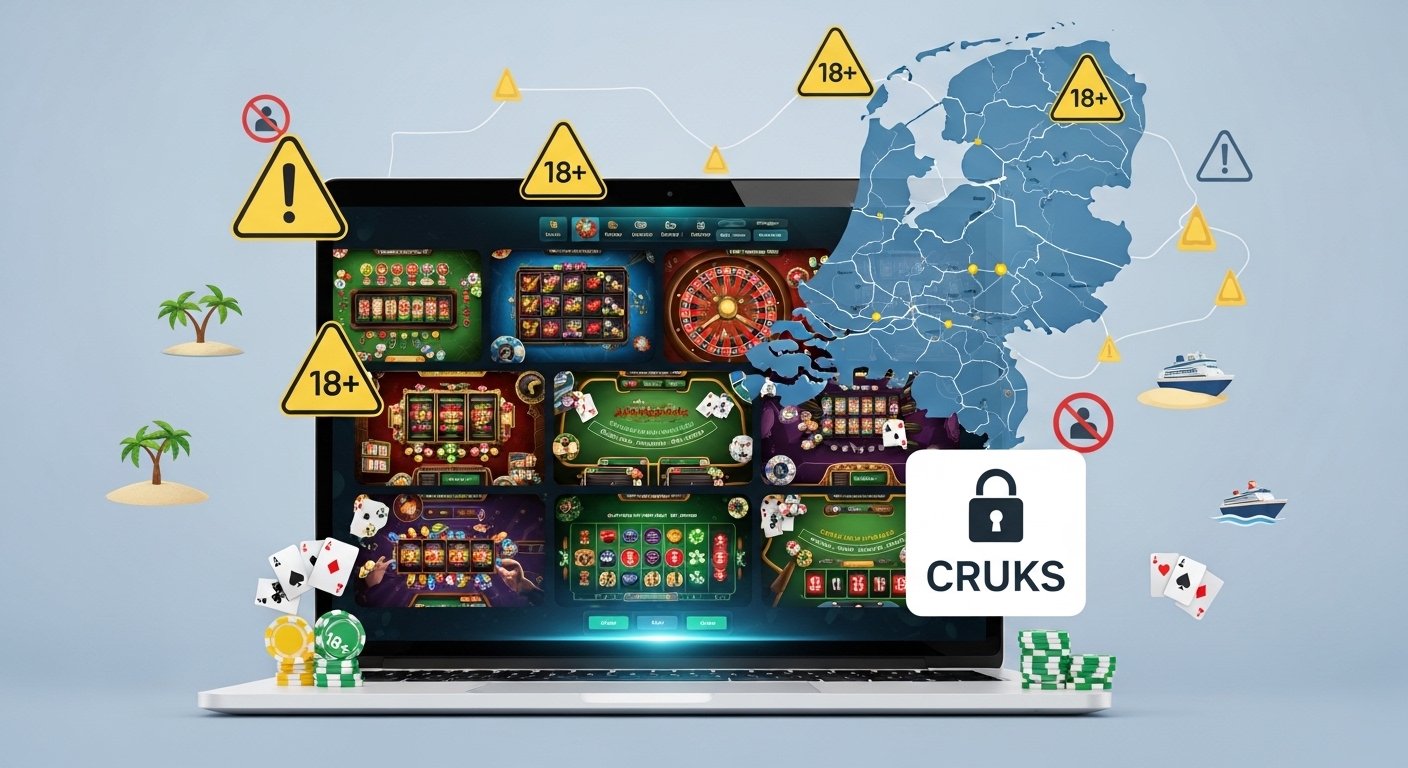
The landscape of the Dutch online gambling market in 2026 stands as a testament to the unintended consequences of high-intensity regulation. When the Remote Gambling Act (KOA) was enacted in April 2021, the prevailing sentiment was one of controlled optimism. The goal was to provide a safe, transparent, and domestic ecosystem that would channel Dutch players away from the “grey” and “black” markets. However, a combination of record-high taxation, increasingly invasive player monitoring, and the inherent globalization of digital gaming has created a friction point that is driving consumers toward international alternatives. This shift has centered around a specific search phenomenon: the “online casino zonder CRUKS,” often navigated through specialized information hubs like storemicgadget.com.
The Evolution of the Dutch Regulatory Framework: KOA to 2026
To understand the current state of the market, one must analyze the legislative foundation laid by the Remote Gambling Act. This act transformed the Netherlands from a country where online gambling was technically prohibited to a strictly regulated environment supervised by the Kansspelautoriteit (KSA). The core of this system is the Centraal Register Uitsluiting Kansspelen (CRUKS), a centralized database designed to provide a “universal stop” for individuals exhibiting signs of gambling addiction or problematic behavior.
The Mechanics and Limitations of the CRUKS Register
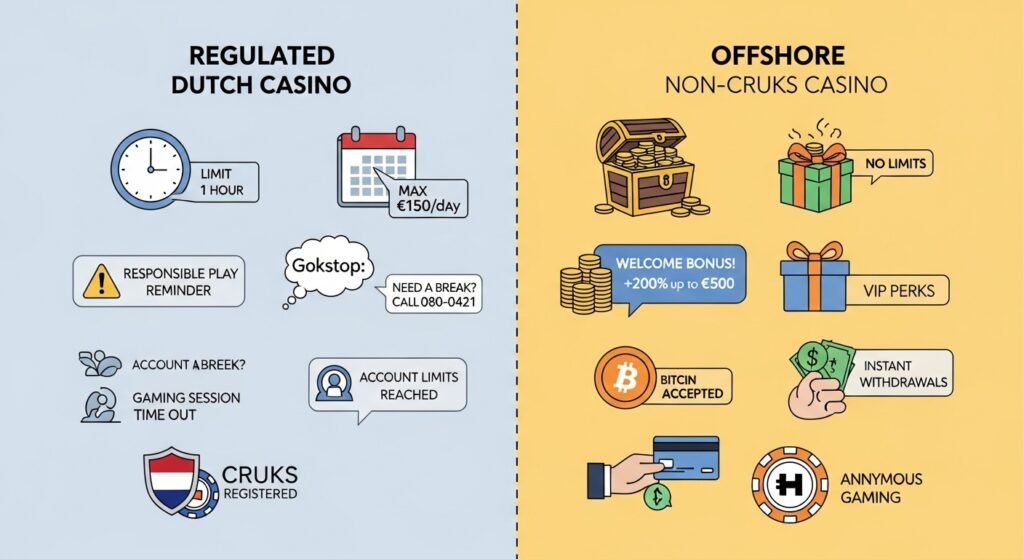
CRUKS operates on a principle of immediate exclusion across all licensed entities. When a player registers—either voluntarily or through intervention by an operator or family member—they are barred from all Dutch-licensed online casinos, land-based arcades, and Holland Casino locations for a minimum period of six months. In 2026, the register has become a point of significant behavioral friction. The primary challenge is not the existence of the register itself, but the “all-or-nothing” nature of its application.
A player who self-excludes during a momentary period of financial stress or emotional distress finds that they are locked out of the entire domestic market even after they have regained control over their habits. This lack of granularity has fostered a demand for platforms that operate outside this centralized net. Research indicates that the psychological drive for autonomy leads players to search for “casinos zonder CRUKS” to reclaim control over their own limits and terms of play.
The Supervisory Agenda of 2026: Tightening the Noose
By 2026, the KSA has shifted its focus from the initial licensing of operators to a more aggressive oversight model. The 2026 Supervisory Agenda emphasizes five key areas: squeezing the illegal market, protecting minors and young adults, strengthening the “duty of care,” ensuring operational integrity, and expanding anti-money laundering (AML) oversight.
One of the most significant shifts in 2026 is the KSA’s targeting of the “infrastructure” behind non-regulated gambling. This includes not just the casinos themselves, but the payment providers, hosting firms, and social media platforms that allow these sites to remain reachable to Dutch consumers. Furthermore, the regulator has begun to closely monitor the marketing chain, specifically focusing on affiliate websites that promote “Casino zonder CRUKS” alternatives.
| Regulatory Pillar | Mandate Under KOA (2021-2025) | Enhanced Enforcement (2026 Priority) |
| Player Exclusion | CRUKS Registry established. | AI-driven behavioral monitoring for earlier intervention. |
| Market Entry | Initial 5-year licenses granted. | Mandatory “Exit Plans” and track-record reviews for renewal. |
| Advertising | Ban on untargeted ads/role models. | Crackdown on influencers, streamers, and affiliate news sites. |
| Young Adult Protection | Higher monitoring for 18-24s. | Hard monthly deposit limits of €300 for 18-24s. |
| Financial Oversight | Basic AML compliance (WWFT). | Sanction list supervision and €3,000 cash limits. |
Source:
The Fiscal Wall: The 37.8 Percent Tax Crisis
Perhaps the most critical driver of market disruption is the Dutch government’s aggressive tax policy. The phased increase of the gambling tax—from 30.5% of Gross Gaming Revenue (GGR) to 34.2% in 2025, and finally to 37.8% on January 1, 2026—has fundamentally altered the economics of iGaming in the Netherlands.
Mathematical Modeling of Operator Viability
The transition to a 37.8% tax rate is not merely a reduction in profit; for many, it is a transition into systemic loss. Industry analysts utilize specific profitability models to illustrate the “squeeze.” If we consider an operator’s net income ($NI$) as a function of GGR ($G$), the tax rate ($T$), and operational costs ($C$):
$$NI = G – (G \times T) – C$$
Where $C$ includes the rising costs of Dutch compliance (integration with the Control Database, manual “duty of care” interventions, and licensing fees).
| Fiscal Year | GGR | Tax Rate | Operational Margin (Estimated) | Net Profit/Loss |
| 2024 | €1,000,000 | 30.5% | €658,550 | +€36,450 |
| 2025 | €1,000,000 | 34.2% | €651,720 | +€6,480 |
| 2026 | €1,000,000 | 37.8% | €650,200 | -€28,000 |
Source:
The implication of this data is profound. To maintain a “financially sound, legal market,” the KSA chairman Michel Groothuizen has acknowledged that providers must be “serious and responsible,” but the tax hike makes it “financially more difficult” for these providers to survive. This fiscal pressure forces regulated operators to make business decisions that are less appealing to players, such as reducing payout percentages (RTP), slashing bonus packages, and limiting game selections, which inadvertently makes the “black market” or offshore alternatives more attractive.
The Impact on State-Owned Entities: Holland Casino
Even Holland Casino, the state-owned bellwether, has expressed “financial pressure” under these conditions. In the first half of 2025, the 34.2% tax rate added an extra €13.5 million to its tax bill. CFO Ruud Bergervoet noted that if the 37.8% rate had been in effect, the profit for the period would have been only €1.1 million—a figure that would have been a loss without the one-time revenue from the sale of properties in Zandvoort and Groningen. This suggests that by 2026, even the most established domestic entities are operating on razor-thin margins, leaving little room for investment in innovation or player protection improvements.
Case Study in Market Response: storemicgadget.com
The search for alternatives to the restrictive Dutch environment has given rise to specialized comparison and information platforms. A prominent example is storemicgadget.com (specifically its Casino020 section), which serves as a navigational tool for Dutch players seeking reliable international casinos that are not part of the CRUKS system.
Content and Purpose of Information Hubs
The primary function of platforms like storemicgadget.com is to provide transparency in an increasingly complex global market. They offer:
- Curated Comparisons: Lists of “Best Online Casinos without CRUKS,” rating platforms like SpinoRhino, Holy Luck, and Koning.Bet based on their security, bonus structures, and payout speeds.
- “Smart Detours”: Since direct iDEAL payments are often blocked by Dutch banks for offshore operators, these sites provide guides on using alternatives such as Volt, MiFinity, and Kryptonim to deposit funds securely.
- Bonus Transparency: They highlight where players can find welcome bonuses up to 725% or €30,000, daily cashback, and the return of features like “Bonus Buy” and “Autoplay” that are banned in the Netherlands.
- Educational Resources: Explaining the registration process (often skipping iDIN) and the specific international licenses that provide a degree of oversight in the absence of KSA supervision.
This indicates a shift in the role of the affiliate. Instead of simply being a marketing conduit, sites like storemicgadget.com have evolved into “consumer advocacy” platforms for a segment of the population that feels over-regulated.
The Globalization of Licensing: MGA vs. Curacao GCB
For players moving outside the CRUKS ecosystem, the primary concern is the reliability and “Experience, Expertise, Authoritativeness, and Trustworthiness” (EEAT) of the offshore platform. This trust is anchored in the licensing jurisdiction of the operator.
The Malta Gaming Authority (MGA): The European Benchmark
The MGA remains the gold standard for offshore gambling in 2026. It offers a “Tier-1” regulatory environment that is widely respected for its strict compliance requirements and player protection policies.
- Financial Integrity: MGA-licensed operators must keep player funds in segregated accounts, distinct from operational capital, ensuring that payouts are guaranteed even in the event of insolvency.
- RNG Certification: Monthly game testing reports and real-time monitoring of Random Number Generators (RNG) are mandatory, often certified by labs like eCOGRA or iTech Labs.
- Dispute Resolution: The MGA provides robust mediation channels, allowing players to escalate complaints if they feel they have been treated unfairly.
The Curacao Modernization (LOK)
Historically, Curacao was viewed as a “hands-off” regulator. However, the introduction of the National Ordinance on Games of Chance (LOK) has centralized power under the Curacao Gaming Control Board (GCB) and overhauled the licensing structure.
| Feature | Curacao GCB (Modernized) | Malta Gaming Authority (MGA) |
| License Structure | Direct B2C/B2B (Master/Sub abolished). | Four specific license classes. |
| Approval Speed | 8 to 12 weeks. | 6 to 12 months. |
| Crypto Support | Fully integrated (BTC, ETH, Stablecoins). | Extremely limited/Not supported. |
| Market Access | Global focus, often VPN-friendly. | Strong European focus, restricted in NL. |
| Cost | Approx. €55,000 (annual/monthly fees). | High (medium application, high compliance). |
Source:
For the modern Dutch player, the Curacao license is often the gateway to “crypto casinos.” Because the GCB allows for payments in virtual assets, it provides a level of speed and anonymity that is impossible within the iDEAL-centric Dutch market.
Payment Innovation: The “Smart Detours” for Dutch Players
As the KSA pressures banks to block iDEAL transactions to non-regulated sites, the market has innovated with sophisticated fintech solutions that maintain the speed of traditional banking while bypassing regulatory friction.
Volt: The Open Banking Champion
Volt has emerged as a primary alternative to iDEAL. Utilizing the European PSD2 framework, Volt allows for instant account-to-account transfers directly from Dutch banks like ING, Rabobank, and ABN Amro. Because it operates via “Open Banking,” it provides the same security and speed as iDEAL but is often available on international platforms that lack a Dutch license.
MiFinity and E-Wallets
MiFinity acts as a multi-currency “hub.” Players can top up their MiFinity wallet using various local methods and then deposit into a casino instantly. This provides a layer of privacy, as the bank statement only reflects a transaction to a payment provider, rather than a gambling site.
The Role of Cryptocurrency in 2026
By 2026, cryptocurrency has moved from a niche interest to a standard banking option in the “Zonder CRUKS” market.
- Speed: Withdrawals are often processed in minutes, compared to the 36-hour average in the regulated Dutch market.
- Privacy: No requirement to share bank details with the operator.
- No Deposit Limits: Crypto payments are not subject to the monthly €700 net deposit cap enforced by the Dutch government.
The Paradox of Player Protection: Channelization and the “Black Market”
The KSA’s top goal for 2026 is to keep at least 90% of players with legal operators. However, research suggests that the regulator may be winning the battle of “player counts” while losing the battle of “GGR volume.”
Channelization Statistics and Economic Reality
In the first four months of 2025, while 91% of players utilized legal websites, those platforms accounted for only 51% of the total Gross Gaming Revenue. This suggests a bifurcation of the market:
- Casual Players: Stay within the regulated Dutch system, making small deposits and following CRUKS rules.
- High-Value/Frequent Players: Move toward non-CRUKS alternatives to bypass the restrictive deposit limits and enjoy higher RTP and bonuses.
The KSA warns that as legal operators reduce payout percentages to absorb the 37.8% tax, the appeal of illegal operators will only increase. The government’s attempt to raise an additional €200 million in tax revenue between 2025 and 2028 may backfire, as early data indicates a €40 million shortfall compared to projections.
Young Adult Protections: 18-24 Year Olds
The KSA is particularly focused on minors and young adults (18-24). In 2026, new rules have set mandatory monthly deposit limits at €300 for this group. While intended to protect vulnerable youth, researchers note that this is the demographic most tech-savvy and capable of finding “Casino zonder CRUKS” alternatives that offer 600% bonuses and no age-based deposit restrictions. The strictness of the domestic market may inadvertently “push” these players into unregulated environments where no “duty of care” exists.
Behavioral Insights: Why Dutch Players Search for “No CRUKS”
To produce a truly insightful report, one must look at the psychological drivers behind the “Zonder CRUKS” phenomenon. It is not always about addiction; often, it is about the “user experience” and “personal freedom”.
The Psychological Drive for Novelty and Autonomy
Gambling and travel share similar psychological parallels: the allure of uncertainty, exploration, and novelty-seeking. When a regulatory body like the KSA imposes “reality checks” every 30 minutes or mandates pop-up messages, it breaks the “flow” of the entertainment experience.
- Autonomy: Players who feel they can manage their own behavior resent the “hand-holding” approach of the CRUKS system.
- Product Superiority: The Dutch ban on “Bonus Buy” features and “Autoplay” is seen as a degradation of the product. International sites offer the “full version” of the game, creating a clear preference for the offshore product.
- Registration Speed: Registration on non-CRUKS sites takes an average of 3 minutes, compared to 15 minutes for the iDIN-heavy Dutch process.
Behavioral Patterns in Non-CRUKS Environments
Research shows a fascinating trend: players on non-CRUKS sites spend significantly more time exploring “free play” or demo modes (45 minutes vs. 20 minutes). This suggests that when players are outside the familiar regulatory framework of the KSA, they actually adopt a more cautious approach, testing the platform’s fairness before committing real money.
Verification Guide: Identifying Safe Non-Regulated Casinos
For Dutch players who choose to use platforms like storemicgadget.com to find alternatives, the “Trustworthiness” pillar of EEAT is paramount. Since these sites are not overseen by the KSA, players must perform their own due diligence.
The Manual Verification Protocol for 2026
| Step | Action | Objective |
| 1. License Validation | Click the license seal (GCB/MGA) in the website footer. | Verify that the license is active and registered to the correct domain. |
| 2. RNG Certification | Search for seals from GLI, iTech Labs, or eCOGRA. | Confirm the games are audited for fairness by a recognized laboratory. |
| 3. Withdrawal Transparency | Read the Terms of Service for payout limits and KYC triggers. | Avoid “hidden” terms that could delay or block winnings. |
| 4. Independent Feedback | Check Reddit or Discord for “real-time” payment proof. | Get unfiltered user experiences beyond affiliate reviews. |
| 5. Technical Security | Check for HTTPS/SSL and 2FA (Two-Factor Authentication). | Protect financial and personal data from deepfake or phishing attacks. |
The most important takeaway for a professional audience is that a “Casino zonder CRUKS” is not a shortcut around responsibility; it is a shift from external state-mandated control to internal personal responsibility.
Conclusion: The Resilience of the Global Market
The state of the Dutch online gambling market in 2026 is a study in the resilience of global digital services against local regulatory barriers. The government’s attempt to create a “closed” ecosystem through the CRUKS register and high taxation has encountered significant friction. While the intention was to maximize player protection and state revenue, the result has been a “fiscal black hole” and the professionalization of the offshore market.
As platforms like storemicgadget.com continue to inform players of their options, the KSA faces a pivotal moment. The 2026 agenda’s focus on targeting “infrastructure” suggests an escalation of the conflict. However, with the rise of crypto payments, VPN-friendly jurisdictions, and decentralized gaming, the ability of a single national regulator to control the digital choices of its citizens is becoming increasingly challenged. For the industry at large, the Netherlands serves as a warning: over-regulation can lead to a less transparent market, where the players who need protection the most are the ones most likely to seek refuge in unregulated waters..