

In the world of financial markets, a trading day refers to any day when a stock exchange or financial market is open for buying and selling securities. Unlike calendar days, which count every day of the year, trading days exclude weekends and officially recognized market holidays. Understanding the number of trading days in a year is essential for traders, investors, and anyone involved in financial planning. This knowledge helps in planning trades, evaluating market strategies, backtesting investment approaches, and setting realistic expectations for annual returns.
In this article, we will explore how many trading days there are in a typical year, the method for calculating them, and how this number varies across different years and global markets. We will also provide examples and official references to give a clear, practical understanding of trading days and their significance in financial decision-making.
What Are Trading Days?
A trading day is a day when a stock exchange or financial market is officially open for buying and selling securities. In simple terms, it is the period during a year when market participants—such as investors and traders—can actively execute trades in stocks, bonds, or other financial instruments. A trading day is not just any calendar day; it is specifically defined by the opening and closing schedules of exchanges like the New York Stock Exchange (NYSE) or the Nasdaq.
In most major stock markets around the world, trading days are limited to weekdays—Monday through Friday—excluding weekends and designated public holidays. This means that if a holiday falls on one of those weekdays, the market will be closed and that day will not count as a trading day.
During a trading day, exchanges typically operate within a set range of hours (for example, many U.S. exchanges are open from morning until mid‑afternoon local time), and all normal transactions occur only within those hours. Any trades that happen outside of these regular hours are considered pre‑market or after‑hours trading and are not counted as part of the official trading day for calendar and statistical purposes.
How Trading Days Affect Market Operations
The number of trading days directly affects market liquidity, price discovery, and strategy planning. For instance, traders often calculate returns and risks based on the number of trading days in a year rather than total days. Analysts and investors also use trading days to backtest trading strategies, compare year‑on‑year performance, and schedule important financial activities such as rebalancing portfolios or assessing volatility.
How Many Trading Days Are There in a Year?
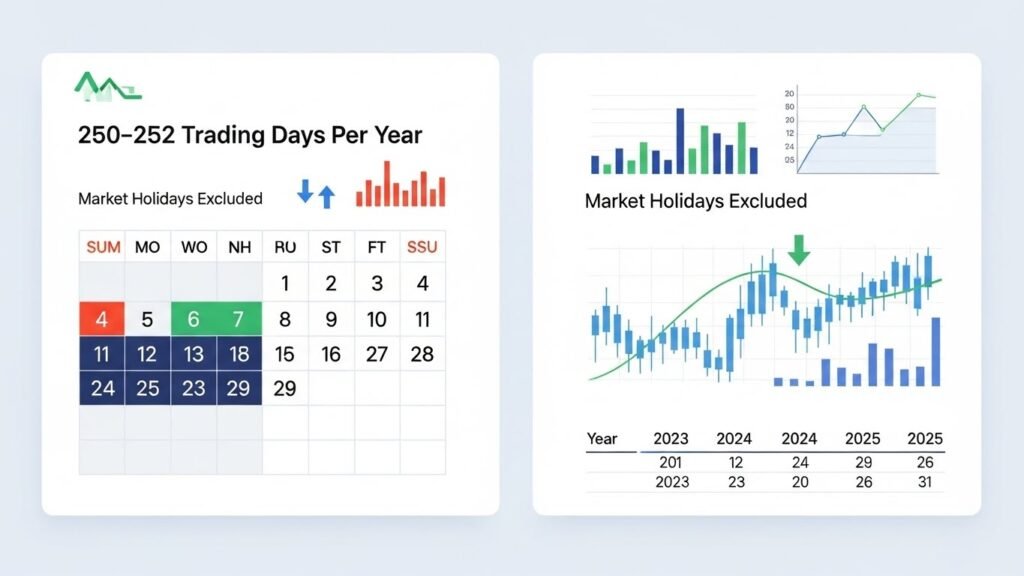
On average, a typical financial market has around 250 to 252 trading days per year. This number can slightly change depending on the calendar year, weekends, and official market holidays. Knowing the number of trading days is important for traders, investors, and analysts when planning strategies, calculating returns, or analyzing market trends.
The number of trading days can be calculated using a simple formula:
Total Days in Year – Weekend Days – Market Holidays ≈ Trading Days
| Year | Trading Days |
|---|---|
| 2023 | 252 |
| 2024 | 251 |
| 2025 | 250–251 |
This calculation assumes that markets are closed on Saturdays and Sundays, as well as on major public or exchange-specific holidays. Because the exact holidays can vary slightly each year, the total trading days may differ by a day or two.
Credible Sources:
- EBC: How Many Trading Days in a Year
- Defcofx: How Many Trading Days in a Year
- Wikipedia: Trading Day
Why the Number of Trading Days Varies
While most financial markets have an average of 250 to 252 trading days per year, the exact number can change slightly from year to year. Several factors influence this variation:
- Holidays Falling on Weekdays vs. Weekends
Stock exchanges are closed on officially recognized holidays. If a holiday falls on a weekday, that day is not counted as a trading day. However, if a holiday falls on a weekend, the market may close on the closest weekday instead, which can shift the total number of trading days. - Leap Years Affecting the Calendar
Leap years add an extra day to the calendar (February 29). Whether this day falls on a weekday or weekend can affect the trading calendar. For example, if February 29 is a Monday, it adds a potential trading day, but if it falls on a Saturday or Sunday, it does not change the trading day count. - Special Closures
Occasionally, markets close unexpectedly due to technical issues, natural disasters, or national events. These special closures are rare but can reduce the number of trading days in a year. - Regional Differences in International Markets
Different countries have different holidays and working weeks, which means the total number of trading days varies by region. For example, the New York Stock Exchange (NYSE) typically has 252 days, while India’s NSE/BSE averages 246–250 trading days due to local holidays.
Understanding these variations is crucial for traders and investors to accurately plan trades, calculate annual returns, and backtest strategies.

Trading Days in Major Markets Around the World
Trading days are not the same across all countries. Each market follows its own trading calendar based on local public holidays, cultural events, and regulatory rules. As a result, global exchanges operate for a different number of trading days each year. Below is an overview of trading days in some of the world’s major financial markets.
United States (NYSE, NASDAQ)
The New York Stock Exchange (NYSE) and NASDAQ are two of the largest stock markets in the world. On average, these U.S. exchanges have around 252 trading days per year. The markets operate from Monday to Friday and remain closed on major U.S. holidays such as New Year’s Day, Independence Day, Thanksgiving, and Christmas.
United Kingdom (London Stock Exchange – LSE)
The London Stock Exchange (LSE) typically has about 253 trading days per year. The slight difference compared to the U.S. market is due to the UK’s specific holidays, including Good Friday and Boxing Day, which influence the annual trading calendar.
India (NSE/BSE)
India’s main stock exchanges, the National Stock Exchange (NSE) and Bombay Stock Exchange (BSE), usually operate for 246 to 250 trading days per year. The variation depends on the number of national and regional holidays, including major festivals and public observances.
Hong Kong (Hong Kong Stock Exchange – HKEX)
The Hong Kong Stock Exchange (HKEX) averages around 247 trading days per year. Trading is affected by local holidays such as Lunar New Year, National Day, and other regional observances, which reduce the total number of trading days.
Comparison Table of Trading Days
| Market / Exchange | Average Trading Days per Year |
|---|---|
| United States (NYSE, NASDAQ) | ~252 |
| United Kingdom (LSE) | ~253 |
| India (NSE/BSE) | 246–250 |
| Hong Kong (HKEX) | ~247 |
This comparison shows why traders and investors involved in international markets must always consider regional trading calendars when planning trades, managing portfolios, or analyzing annual performance.

How to Calculate Trading Days Yourself
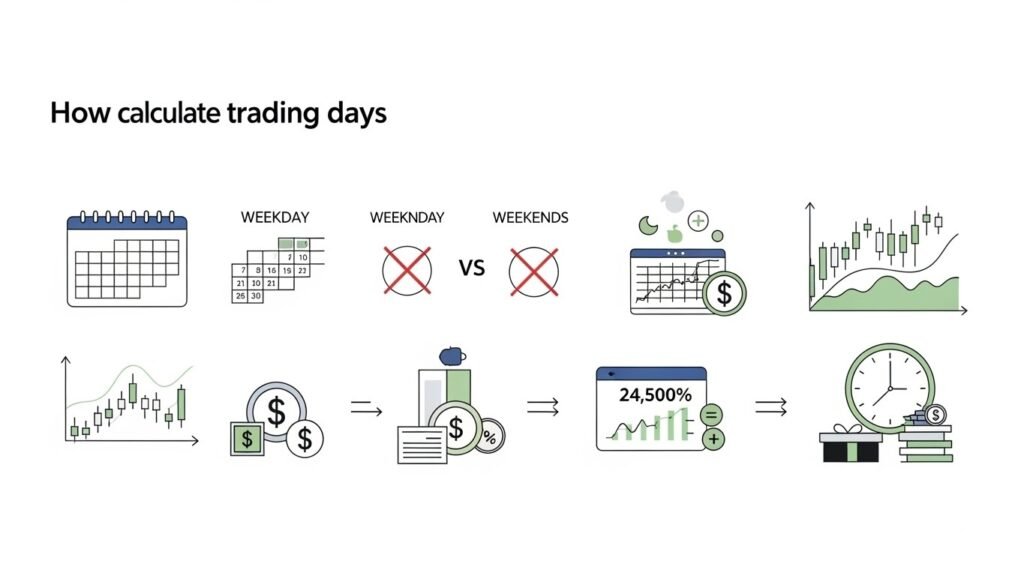
Calculating the number of trading days in a year is simple if you follow a clear step-by-step process. This method is useful for traders, investors, and analysts who want accurate data for planning, backtesting strategies, or estimating annual performance.
Step-by-Step Guide
Step 1: Start with the Total Days in the Year
A normal year has 365 days, while a leap year has 366 days. This is the starting point for the calculation.
Step 2: Subtract Weekend Days
Most stock markets are closed on Saturdays and Sundays.
There are 52 weeks in a year, which means:
- 52 × 2 = 104 weekend days
Subtract these from the total days.
Step 3: Subtract Public and Market Holidays
Stock exchanges are also closed on official holidays.
These holidays vary by country and exchange, but most major markets have 9 to 15 holidays per year. Subtract the total number of holidays that fall on weekdays.
Optional Formula (Including Leap Years)
Trading Days = Total Days in Year − Weekend Days − Market Holidays
For leap years:
Trading Days = 366 − 104 − Market Holidays
Example Calculation for 2025
- Total days in 2025: 365
- Weekend days: 104
- Market holidays (approx.): 10
365 − 104 − 10 = 251 trading days
So, 2025 is expected to have approximately 250–251 trading days, depending on how holidays are officially observed by the exchange.
By using this method, you can easily calculate trading days for any year and any market by adjusting the number of holidays according to the official exchange calendar.
Importance of Knowing Trading Days
Understanding the number of trading days in a year is crucial for traders and investors because it directly affects how financial strategies are planned, tested, and evaluated. Trading days provide a realistic framework for measuring market performance and making informed decisions.
Strategy Planning and Backtesting
Traders and analysts use trading days to design and backtest trading strategies. When testing a strategy on historical data, results are measured over trading days rather than calendar days. This ensures accuracy in performance metrics such as average daily returns, drawdowns, and win rates. Without using the correct number of trading days, strategy results can be misleading.
Understanding Market Volatility Cycles
Market volatility often follows patterns that are best analyzed using trading days. Events like earnings reports, economic data releases, and policy announcements occur on trading days and influence price movements. By understanding how many trading days are in a year, traders can better evaluate volatility cycles, market momentum, and seasonal trends.
Setting Realistic Targets for Annual Returns
Investors often calculate expected returns based on daily or weekly performance multiplied by the number of trading days. Knowing the correct trading-day count helps in setting achievable profit targets and managing expectations. It also allows for accurate comparisons between different years, portfolios, or trading systems.
Overall, knowing the number of trading days helps market participants measure performance correctly, reduce planning errors, and make more disciplined financial decisions.

Conclusion
In summary, most major financial markets operate for an average of 250 to 252 trading days per year. This number is not fixed and can change slightly depending on factors such as weekends, public holidays, leap years, and occasional special market closures. Because each country and exchange follows its own holiday calendar, trading days can also vary across different regions.
Understanding the number of trading days is essential for traders, investors, and financial planners. It helps in accurately planning trading strategies, backtesting historical performance, analyzing market volatility, and setting realistic annual return targets. Using trading days instead of calendar days provides a more accurate picture of market activity and performance.
To avoid errors and ensure precise calculations, readers are strongly encouraged to check the official trading calendar of the relevant stock exchange each year. This practice ensures better planning, informed decision-making, and a more disciplined approach to participating in financial markets.
References / Sources
To ensure accuracy and credibility, the information in this article is supported by well-known financial and educational sources. Readers can explore these links for deeper understanding and official confirmations:
- EBC Financial Group – How Many Trading Days in a Year
https://www.ebc.com/forex/how-many-trading-days-in-a-year - Defcofx – How Many Trading Days in a Year
https://www.defcofx.com/how-many-trading-days-in-a-year/ - Wikipedia – Trading Day
https://en.wikipedia.org/wiki/Trading_day - CoinCodex – How Many Trading Days in a Year
https://coincodex.com/article/32545/how-many-trading-days-in-a-year/
These sources explain trading days from both educational and practical market perspectives and are widely referenced in the finance industry.
FAQ’s
No, weekends do not count as trading days. Most major stock markets around the world are closed on Saturdays and Sundays. Trading activity is limited to weekdays, usually from Monday to Friday, except on official market holidays. Because of this, weekends are excluded when calculating the total number of trading days in a year.
Holidays reduce the total number of trading days because stock exchanges remain closed on official public or market-specific holidays. If a holiday falls on a weekday, that day is removed from the trading calendar. In some cases, when a holiday falls on a weekend, the market may close on the nearest weekday, which can also affect the total trading-day count for the year.
Early afternoon, allowing for a post-trade review or active participation in earnings volatility before the days end at 5:00 PM PST.4 This schedule requires a meticulous configuration ofExtended