
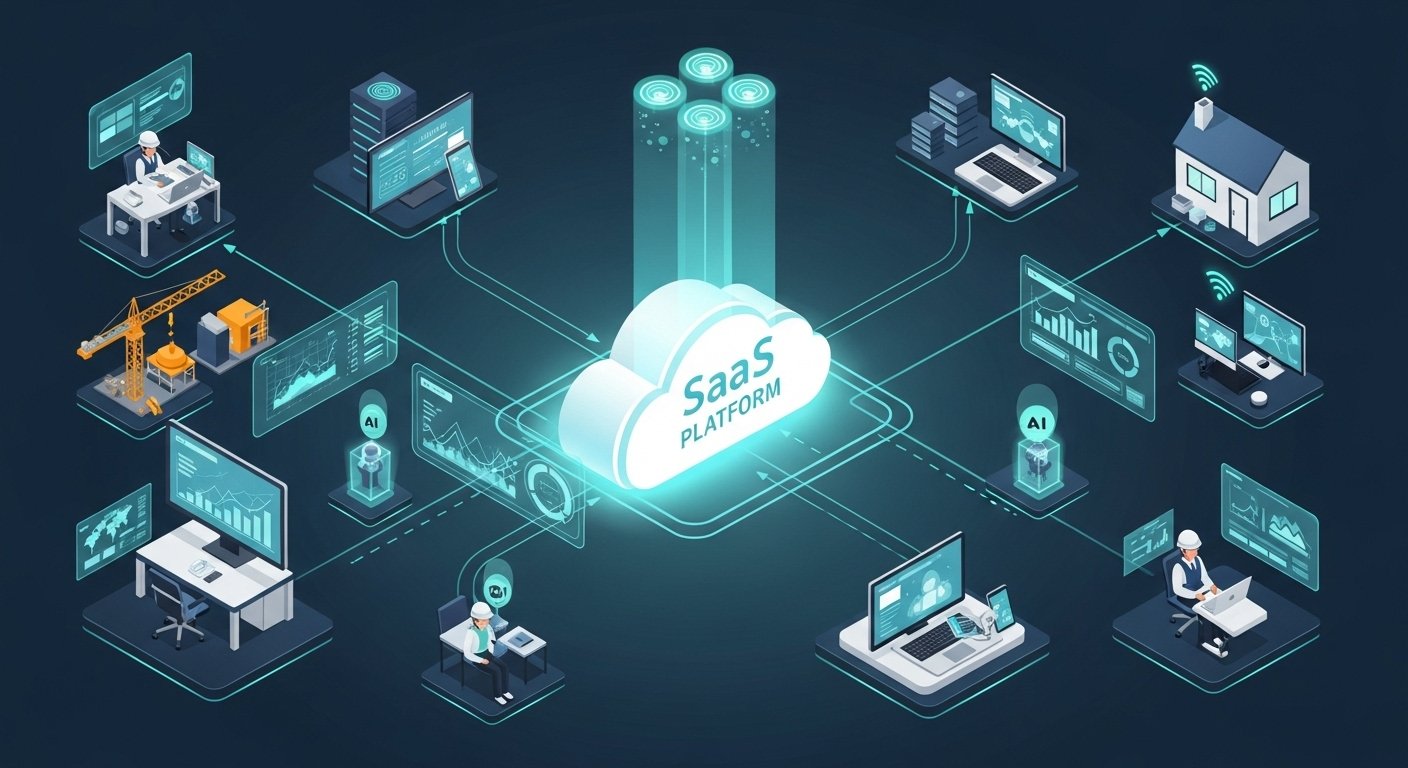
SaaS とは – What Is Software as a Service?
The global shift toward cloud computing has redefined the foundational architecture of modern commerce, particularly through the model known as SaaS とは. In the context of the Japanese market, SaaS (Software as a Service) represents much more than a technical delivery method; it is a critical instrument for national digital transformation (DX) and a primary solution to the acute labor shortages facing the archipelago.1 To understand the concept comprehensively, one must view it through a dual lens: as a technological evolution from locally installed software and as a business model shift from ownership to utility-based consumption.4
SaaS とは何か (What is SaaS?) In its simplest terms, it is a mechanism where software is provided via the internet as a cloud service.1 Unlike the traditional “kaikiri” or purchase-to-own model, where users had to buy physical media and install it on specific hardware, SaaS allows users to access the latest applications through a web browser or a mobile application.6 The software itself runs on the service provider’s servers, meaning the provider—rather than the user—is responsible for managing the infrastructure, maintaining the code, and ensuring security.9 This shift in responsibility is a hallmark of the cloud era, enabling companies to focus their intellectual capital on their core business rather than on system maintenance.11
The importance of SaaS in the current Japanese economic climate cannot be overstated. As businesses approach the “2025 Digital Cliff”—a term coined by the Ministry of Economy, Trade and Industry (METI) to describe the economic loss of up to ¥12 trillion per year due to aging legacy systems—SaaS serves as the primary bridge to modernization.13 By adopting cloud-native applications, Japanese firms can bypass the complexities of updating 20-year-old COBOL systems and leapfrog into an era defined by AI integration, real-time data flow, and remote collaboration.13 This guide provides a deep-dive analysis into the architecture, economics, and future trajectory of SaaS within the Japanese and global landscapes.
SaaS とは何ですか?
SaaS とは 意味 (the meaning of SaaS) can be explained most effectively to a beginner as “software you use over the internet without installing it”.1 Historically, if an office wanted to use a spreadsheet program, they would buy a box containing a CD-ROM or a license key, install it on a specific PC, and that software would live only on that machine. If the software was updated, the user had to buy a new version.6 SaaS とは 簡単に (to put it simply), this old method is like buying a car, while SaaS is like using a ride-sharing service or a subscription for a train pass. You pay for the right to use the service, and the provider takes care of the “vehicle” (the software and servers).6
For Japanese companies, this model offers several immediate practicalities. First, it enables “telework” (remote work) because employees can log in to their work tools from home using any device with an internet connection.2 Second, it allows for “simultaneous editing,” meaning multiple team members can work on the same document or project at once, with all changes saved automatically in the cloud.4 Third, it removes the need for a dedicated IT room filled with expensive servers, as the “cloud” handles all the heavy lifting.6 In the modern era, popular examples like Gmail, Zoom, and Slack have become the standard, proving that the internet is the new operating system for business.7

What Is SaaS? Technical Foundations and Formal Definitions
To move beyond a beginner’s understanding, we must look at the formal definitions recognized by global technology leaders. According to the, Software as a Service is defined as software that is “owned, delivered, and managed remotely by one or more providers”.5 This definition emphasizes three core pillars: external ownership, remote delivery, and a one-to-many consumption model.5
| Technical Pillar | Description | Impact on Enterprise IT |
| Common Code Base | The provider maintains a single version of the software for all customers.5 | Updates are applied once and benefit everyone simultaneously.19 |
| Multi-Tenancy | Multiple customers (tenants) share the same underlying infrastructure and database.19 | High cost-efficiency and easier resource scaling for the provider.19 |
| Remote Hosting | The application runs on the provider’s servers, accessible via the public internet.9 | Eliminates the need for local hardware maintenance and on-site cooling.6 |
| Pay-for-Use/Subscription | Pricing is based on metrics like user count, data volume, or time.5 | Predictable operational costs and low entry barriers.6 |
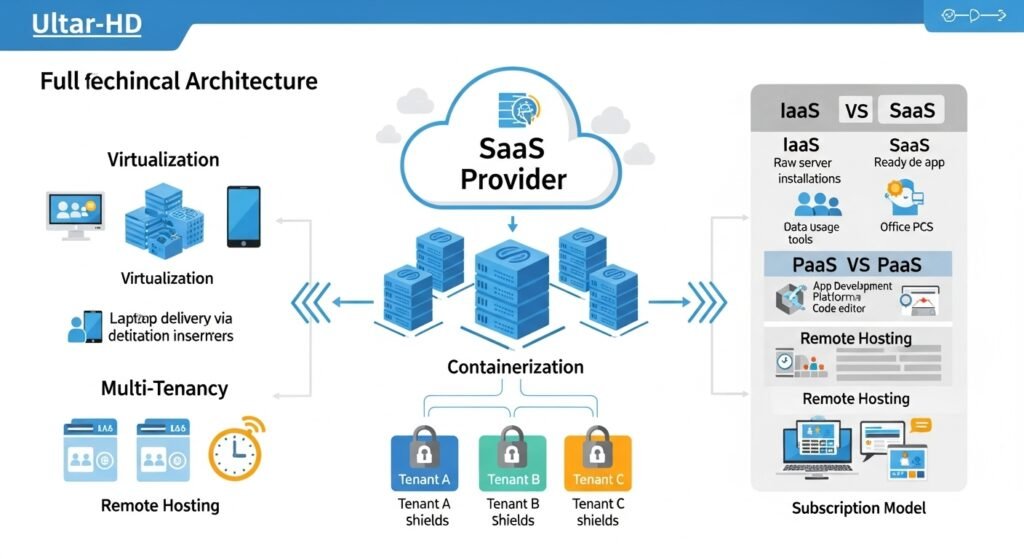
The technical architecture of SaaS relies heavily on virtualization and, increasingly, containerization. Virtualization allows a single physical server to be divided into multiple “virtual machines,” each acting as an independent computer. SaaS providers use this to host thousands of customers on a centralized server farm.9 Multi-tenancy is the specific architectural pattern where these customers share the same application instance while their data remains logically isolated.19 This isolation is critical; even though two competing Japanese firms might use the same CRM SaaS, the software’s “tenant isolation” protocols ensure that Firm A can never see Firm B’s data.23
Furthermore, SaaS is distinct from other cloud models like IaaS (Infrastructure as a Service) and PaaS (Platform as a Service) by its “ready-to-use” nature. In IaaS, you rent a virtual server and must install the OS yourself. In PaaS, you get a platform to build your own apps. In SaaS, you are provided with the finished product—the software application itself.7 This high level of abstraction is why SaaS has the highest adoption rate among the three cloud models in Japan.24
SaaS Business Model and the Economics of Subscriptions
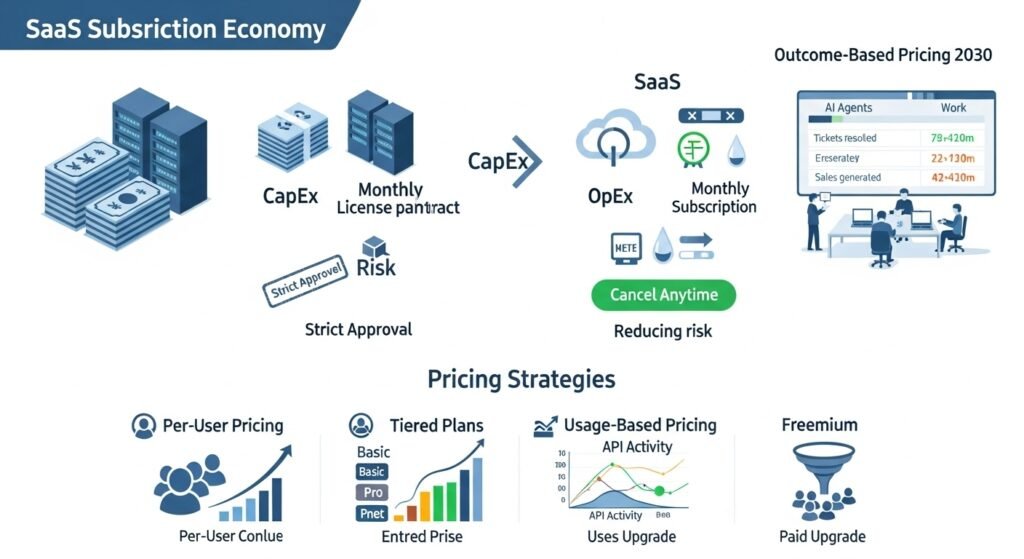
The transformation of the software industry into SaaS has fundamentally altered the financial relationship between vendors and customers. The primary driver of this shift is the “subscription economy”.15 For a Japanese enterprise, the SaaS business model replaces a high one-time capital expenditure (CapEx) with a lower, recurring operating expense (OpEx).6
The Shift from CapEx to OpEx
In traditional software procurement, a company would buy a perpetual license, which often cost millions of yen and sat on the balance sheet as an asset.6 This required a rigorous approval process because it was a significant “sunken cost.” With SaaS, the software is treated as a service, similar to electricity or water.5 If the software no longer provides value, the Japanese business can simply cancel the subscription at the end of the term, significantly reducing the “risk of failure”.7
Pricing Strategies and Value Metrics
SaaS providers in Japan utilize several pricing models to cater to different segments of the market:
- Per-User/Per-Seat Pricing: The most common model, where the cost scales with the number of employees using the tool.19
- Tiered Pricing: Offering “Basic,” “Pro,” and “Enterprise” levels with varying features and limits.17
- Usage-Based (Consumption) Pricing: Charges are based on data used, emails sent, or API calls made. This is becoming more popular as AI agents begin to perform tasks that don’t correspond to human “seats”.26
- Freemium: Offering a basic version for free to encourage adoption, with a paid upgrade for advanced features.7
| Pricing Model | Best For | Potential Drawback |
| Per-User | Predictable budgeting for growing teams.19 | Can become expensive as the head count increases.30 |
| Tiered | Matching specific feature needs to budget.17 | Users might pay for features they don’t actually use.29 |
| Usage-Based | Aligning cost directly with actual value delivered.27 | Monthly bills can be unpredictable and fluctuate.31 |
| Freemium | Viral adoption and testing product-market fit.7 | Low conversion rates and high support costs for free users. |
The “SaaS Reimagined” Evolution
As we move toward 2030, the business model is evolving. Analysts suggest that the traditional per-seat model will become “obsolete” by 2028 because “digital labor” (AI) will replace human interaction.27 Instead of paying for 10 seats for customer service reps, a Japanese firm might pay for “outcomes,” such as the number of tickets resolved or the volume of sales generated by an autonomous agent.15 This shift reflects a deepening maturity in the SaaS industry, where the focus moves from the tool to the result.27
SaaS Examples: From Global Giants to Japanese Success Stories
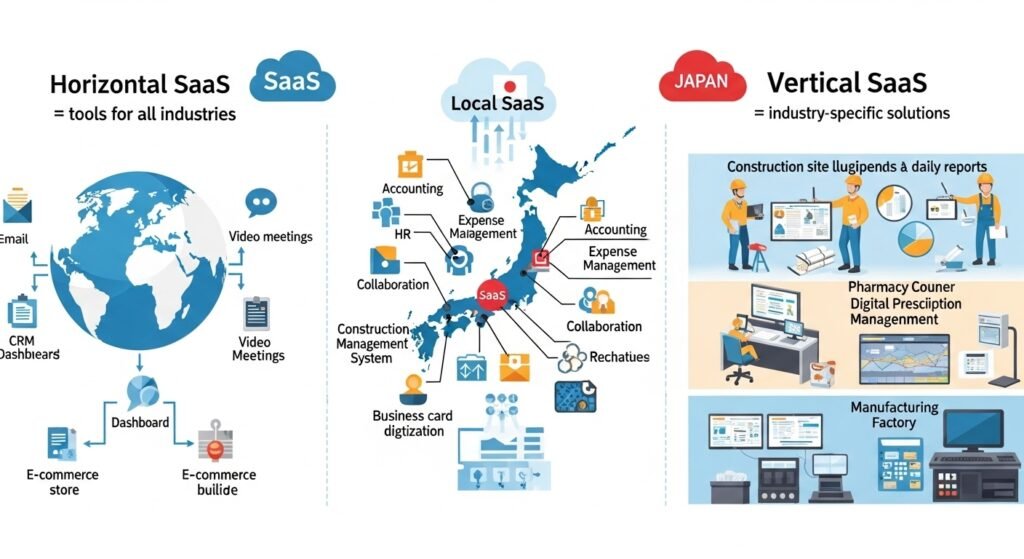
To understand SaaS とは in practice, one must look at the diverse array of companies providing these services. The market is broadly divided into “Horizontal SaaS” (tools used across all industries) and “Vertical SaaS” (tools built for specific industries).30
Leading Global Examples
- Google Workspace: Perhaps the most ubiquitous SaaS, it provides email (Gmail), document editing (Docs), and storage (Drive) entirely within the browser.7
- Salesforce: The pioneer of SaaS, providing a Customer Relationship Management (CRM) platform that helps businesses track sales leads and customer interactions.17
- Slack: A communication platform that has largely replaced internal email for thousands of Japanese startups and enterprises.7
- Zoom: A video conferencing tool that became an essential piece of social and business infrastructure during the telework shift.7
- Shopify: An e-commerce platform that allows businesses to build online stores without managing their own hosting or security.27
Top Japanese SaaS Companies
The Japanese SaaS ecosystem is robust, with several players achieving significant market capitalization and deep penetration into local workflows.
| Company Name | Focus Area | Key Impact on Japanese Business |
| Sansan | Business Card/Contact Management | Digitizing Japan’s “meishi” (business card) culture into a searchable CRM database.35 |
| Money Forward | Accounting & Finance | Automating bookkeeping and tax filings to comply with local laws.35 |
| Freee | ERP & HR | Simplifying payroll and human resource management for Japanese SMEs.35 |
| Rakus | Expense/Mail Management | Streamlining “Keishi” (expense) reporting, a high-friction task in Japanese offices.35 |
| Cybozu | Collaboration/Groupware | Providing “Kintone,” a no-code platform for building internal workflow apps.35 |
| ANDPAD | Construction Management | The top vertical SaaS for Japan’s construction sector, managing blueprints and site data.37 |
Deep Dive: Vertical SaaS and Industry-Specific Solutions
While horizontal tools like Slack are useful, the real growth in 2024-2025 is occurring in Vertical SaaS.32 These are products designed to solve specific problems in niche markets. In Japan, this is particularly evident in:
- Construction (ANDPAD): Traditionally a paper-heavy industry, ANDPAD allows site managers to share blueprints and daily reports via smartphone, saving up to one hour of travel time per day per supervisor.28
- Healthcare (KAKEHASHI): Specialized SaaS for pharmacies that streamlines the prescription and medication guidance process, addressing the needs of Japan’s aging population.3
- Manufacturing (CADDi): A platform for managing the complex procurement and supply chain needs of the Japanese manufacturing sector.32
SaaS vs. Traditional Software: A Strategic Comparison
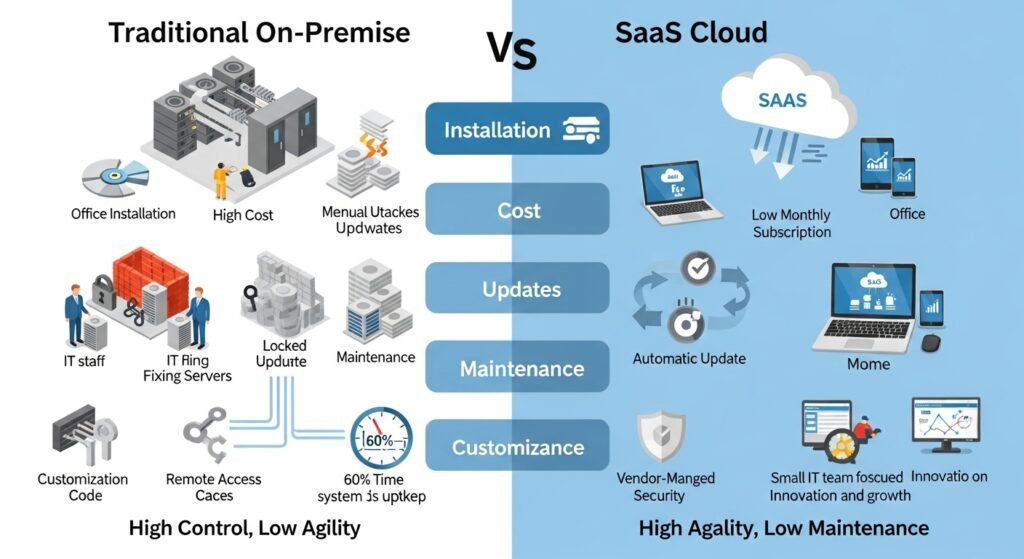
To justify a migration to the cloud, Japanese IT leaders often compare SaaS against “on-premise” or “packaged” software. The differences extend across installation, cost, updates, and accessibility.7
| Comparison Feature | Traditional (On-Premise) | SaaS (Cloud) |
| Installation | Manual install on each PC/server; requires CD-ROM or download.6 | Instant access via browser; no local installation needed.6 |
| Upfront Cost | High initial investment for hardware and perpetual licenses.6 | Low entry cost; subscription fees spread over time.6 |
| Updates | User must manually apply patches or buy new versions.6 | Automatic updates; user always has the latest features.6 |
| Maintenance | Internal IT team responsible for hardware/security.6 | Vendor handles all hardware, security, and uptime.6 |
| Remote Access | Requires complex VPN or only works in-office.4 | Native internet access; works from anywhere.4 |
| Customization | High; can modify code to fit proprietary processes.7 | Lower; usually limited to configuration settings.7 |
The trade-off is often between control and agility. On-premise systems allow a Japanese firm to keep everything behind their own firewall and customize the code to an infinite degree, which is often preferred by highly conservative or specialized sectors.7 However, this control comes with the “maintenance burden”—60% of an IT team’s time is typically spent just keeping old systems running.11 SaaS eliminates this burden, allowing the team to focus on innovation instead.11
Strategic Benefits and Advantages of SaaS
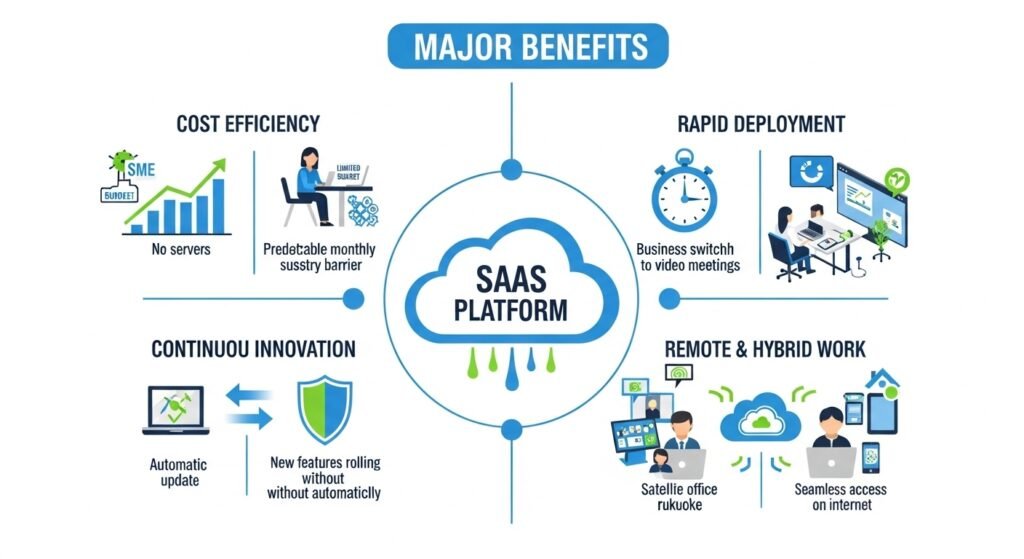
The adoption of SaaS offers a suite of advantages that align with Japan’s national goal of increasing labor productivity through technology.2
1. Cost Efficiency and Predictability
By removing the need for physical servers and upfront licensing, SaaS lowers the “barrier to entry” for digital transformation.6 This is critical for Japan’s 3.5 million SMEs, which often lack the capital for large-scale IT projects.3 The subscription model also makes budgeting predictable, as costs scale linearly with usage or head count.6
2. Rapid Deployment and “Time to Value”
Traditional software projects in Japan can take months or years of planning, procurement, and installation. A SaaS product can often be “turned on” in minutes.8 This speed allows businesses to react quickly to market changes, such as the sudden need for video conferencing in 2020.41
3. Automatic “Continuous” Innovation
In the SaaS world, there is no “Version 10.0” followed three years later by “Version 11.0.” Instead, vendors push small updates every week or month.6 This ensures that Japanese companies are always using the most secure and feature-rich version of the software without needing to schedule downtime for major upgrades.6
4. Native Support for the “New Normal” (Remote Work)
SaaS is the backbone of the hybrid work era. Because it resides on the internet, it provides a seamless experience whether an employee is at the head office in Otemachi, a satellite office in Fukuoka, or working from home.2 This flexibility is a key differentiator in the war for talent, as younger Japanese workers increasingly prioritize flexible work environments.2
Disadvantages, Risks, and Security Realities
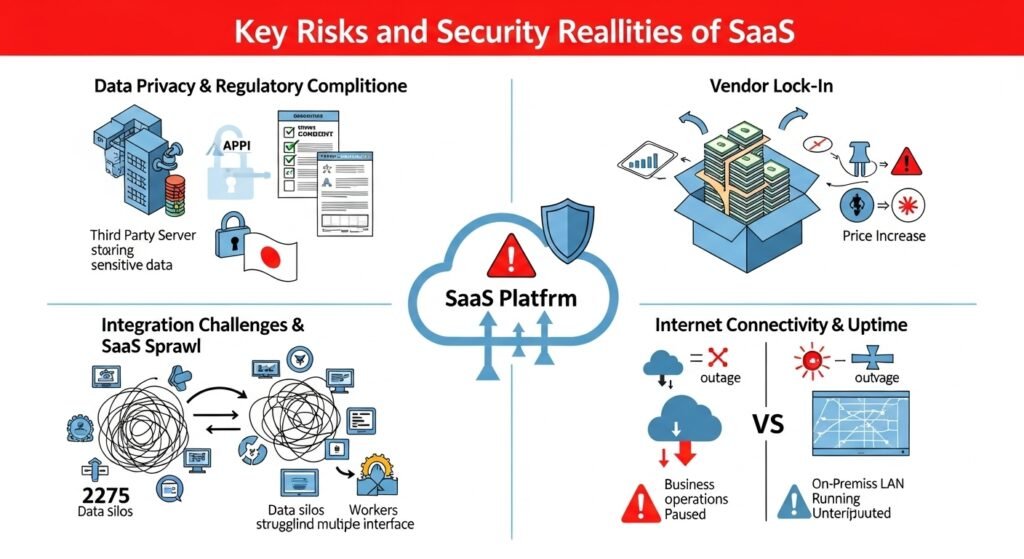
While the benefits are substantial, a comprehensive analysis of SaaS とは must also address the “Achilles’ heel” of the model: security, dependence, and the loss of absolute control.7
1. Data Privacy and Regulatory Compliance
Storing data on a third-party server creates a “trust gap.” For Japanese firms, this is specifically regulated by the Act on the Protection of Personal Information (APPI). If a SaaS provider stores data on a server in a foreign country, the Japanese business must ensure they have user consent and that the provider meets strict security standards.42
2. The Danger of “Vendor Lock-In”
Once a company has stored five years of financial data in a specific SaaS, moving to a competitor is extremely difficult. The data formats may be proprietary, and the “export” tools may be limited.7 This creates a dependency where the vendor can raise prices or change terms, and the customer has little choice but to comply.7
3. Integration Challenges and “SaaS Sprawl”
The average enterprise now manages over 275 SaaS applications.29 Without a central strategy, different departments might buy different tools that don’t talk to each other, creating “data silos”.27 This fragmentation can actually decrease productivity as workers spend time switching between dozens of different interfaces daily.27
4. Internet Connectivity and Uptime
If the internet goes down, the work stops. While major providers like AWS or Google have 99.9% uptime, localized outages or DNS issues can still disrupt business operations.7 This is a risk that on-premise systems, which can work on a local area network (LAN), do not face to the same degree.7
SaaS Use Cases by Industry: A Multi-Sector Analysis
The versatility of SaaS is demonstrated by its wide range of applications across the Japanese economy.
1. Business and Operations (Horizontal SaaS)
- CRM (Customer Relationship Management): Salesforce and Sansan are used to manage sales pipelines and business connections.17
- ERP (Enterprise Resource Planning): NetSuite or SAP S/4HANA Cloud manage the entire “back office,” including finance, supply chain, and HR.17
- Communication: Slack and Microsoft Teams are the nervous system of modern organizations.7
2. Construction and Real Estate (Vertical SaaS)
- ANDPAD: Used by 10% of Japan’s construction workers for site management.37
- SpiderPlus: Manages blueprints and site coordination for general contractors.32
- estie: A platform for commercial real estate data intelligence.46
3. Healthcare and Education
- KAKEHASHI: Pharmaceutical workflow management.3
- Online Learning (EdTech): Platforms like Coursera or local Japanese equivalents provide training and skill development via SaaS.17
4. Marketing and Sales
- HubSpot: An all-in-one platform for inbound marketing, sales, and service.34
- Appier: AI-driven marketing automation tailored for the Asia-Pacific market.35
SaaS とは ビジネスにどう役立つ?
ビジネスにおいて SaaS とは (SaaS in business) can be categorized as a “productivity multiplier.” In Japan, where the working-age population is shrinking, companies cannot simply “hire more people” to grow. They must “automate more tasks”.3 SaaS helps this by:
- Removing Low-Value Labor: Automated invoicing in Money Forward or auto-transcription in Zoom replaces hours of manual work.8
- Centralizing Intelligence: By putting all customer data in one cloud (like Salesforce), management can see real-time “predictive analytics” to make better decisions.3
- Facilitating “Agile” Growth: If a company wants to launch a new department, they don’t need to wait six months for IT to build a system. They just buy a new SaaS subscription and start working the next day.9
One specific example of business utility is in the construction industry. Before SaaS, a supervisor had to drive to the head office just to pick up a paper blueprint. With ANDPAD, they see the latest blueprint on their iPad at the site. This “1-hour reduction in work per day” allows them to manage more projects without increasing staff.28

The Future of SaaS: AI, Agentic Workflows, and 2025-2026
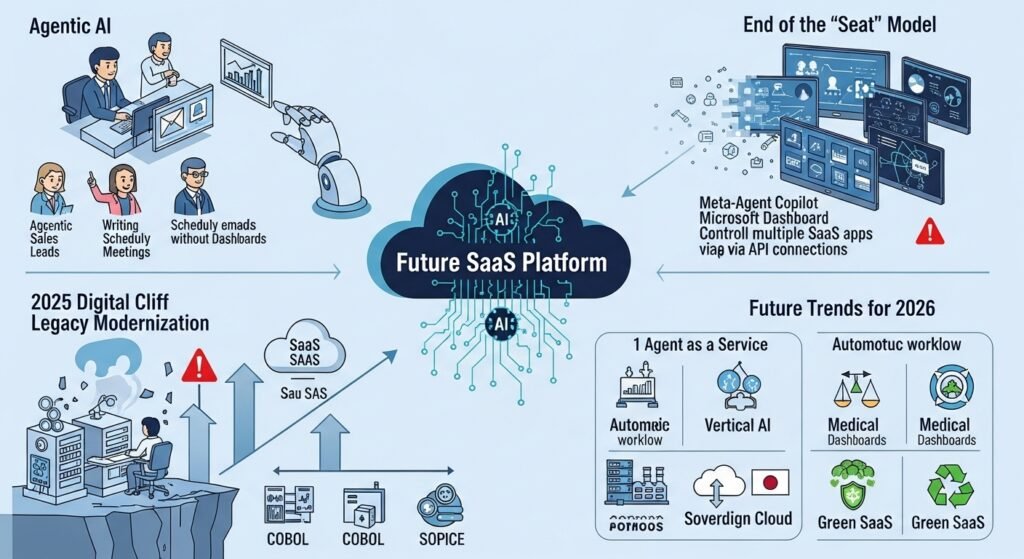
The trajectory of SaaS is now inextricably linked to the progress of Artificial Intelligence. We are entering a new chapter where SaaS is “metamorphosing” from a static interface into a proactive agent.15
The Rise of Agentic AI
According to Gartner, “Agentic AI” is a top strategic trend for 2025.47 Unlike traditional AI, which only answers questions, Agentic AI can take action. In a SaaS context, this means an agent could autonomously research a sales lead, write a personalized email, schedule a meeting, and update the CRM without human intervention.48
The End of the “Seat” Model?
Microsoft CEO Satya Nadella’s provocative statement that “SaaS is dead” refers to the death of the traditional SaaS interface.27 In the future, users might not log in to dozens of different “screens.” Instead, they will interact with a single “Meta-Agent” (like Microsoft Copilot) that uses APIs to talk to all the underlying SaaS platforms.27
“2025 Digital Cliff” and Legacy Modernization
The year 2025 is a critical deadline for Japanese companies. As outlined in the (https://www.meti.go.jp/english/press/2025/0528_001.html), companies that fail to migrate from legacy systems to the cloud (SaaS) risk severe economic losses and system failures.13 This “Digital Cliff” is driving a massive wave of cloud migration among Japanese SMEs and large enterprises alike.13
| Future Trend | Description | Impact for 2026 |
| Agent as a Service | Autonomous agents that perform complex workflows.15 | Reduced need for manual data entry and UI interaction.27 |
| Vertical AI | AI models fine-tuned for specific industries like Law or Med.15 | Higher precision and compliance in specialized tasks.15 |
| Sovereign Cloud | SaaS platforms hosted entirely within Japan to meet data laws.24 | Increased trust and adoption by government and finance.24 |
| Sustainability (Green SaaS) | Using renewable-powered data centers and efficient code.26 | Alignment with global ESG (Environmental, Social, Governance) goals.3 |
Frequently Asked Questions (FAQ)
SaaS(サース)とは、インターネット経由でソフトウェアを利用する仕組みです。PCにインストールする必要がなく、月額料金などで手軽に始められます。GmailやZoomなどが身近な例です.1
「クラウド」はインターネットを通じて提供されるITリソース全体の総称です。「SaaS」はその中のひとつの形態で、具体的に「ソフトウェア」を提供するものを指します.6
基本的には、大手ベンダーが提供するSaaSは高度なセキュリティ対策が施されており、自社で管理するよりも安全な場合が多いです。ただし、日本の個人情報保護法(APPI)への準拠や、パスワード管理などのユーザー側の対策も重要です.43
名刺管理の「Sansan」、会計ソフトの「マネーフォワード」や「freee」、建設管理の「ANDPAD」、そして「Slack」や「Zoom」などが広く利用されています.35
「サブスクリプション方式」が一般的で、月額または年額で料金を支払います。ユーザー数に応じた「ID課金」や、使った分だけ払う「従量課金」などがあります.5
Conclusion: Navigating the SaaS Era in Japan
The transition to SaaS とは is not merely a technical upgrade; it is a fundamental reconfiguration of how Japanese organizations create and deliver value. As we move past 2025, the focus is shifting from simple cloud migration to the sophisticated orchestration of autonomous agents and industry-specific vertical solutions.15 For the Japanese business leader, the priority must be to move beyond “legacy thinking”—the desire for perfect customization and on-site control—and embrace the agility, scalability, and continuous innovation that only the SaaS model can provide.11 By doing so, Japan can turn the “Digital Cliff” into a digital launchpad, securing its position as a global leader in the data-driven economy.